
AI Boom Breaks Traditional Stock-Currency Link Across Asia-Pacific
AI boom is decoupling Asian stocks from currencies, forcing CMOs to rethink regional hedging strategies and investment exposure across the region.

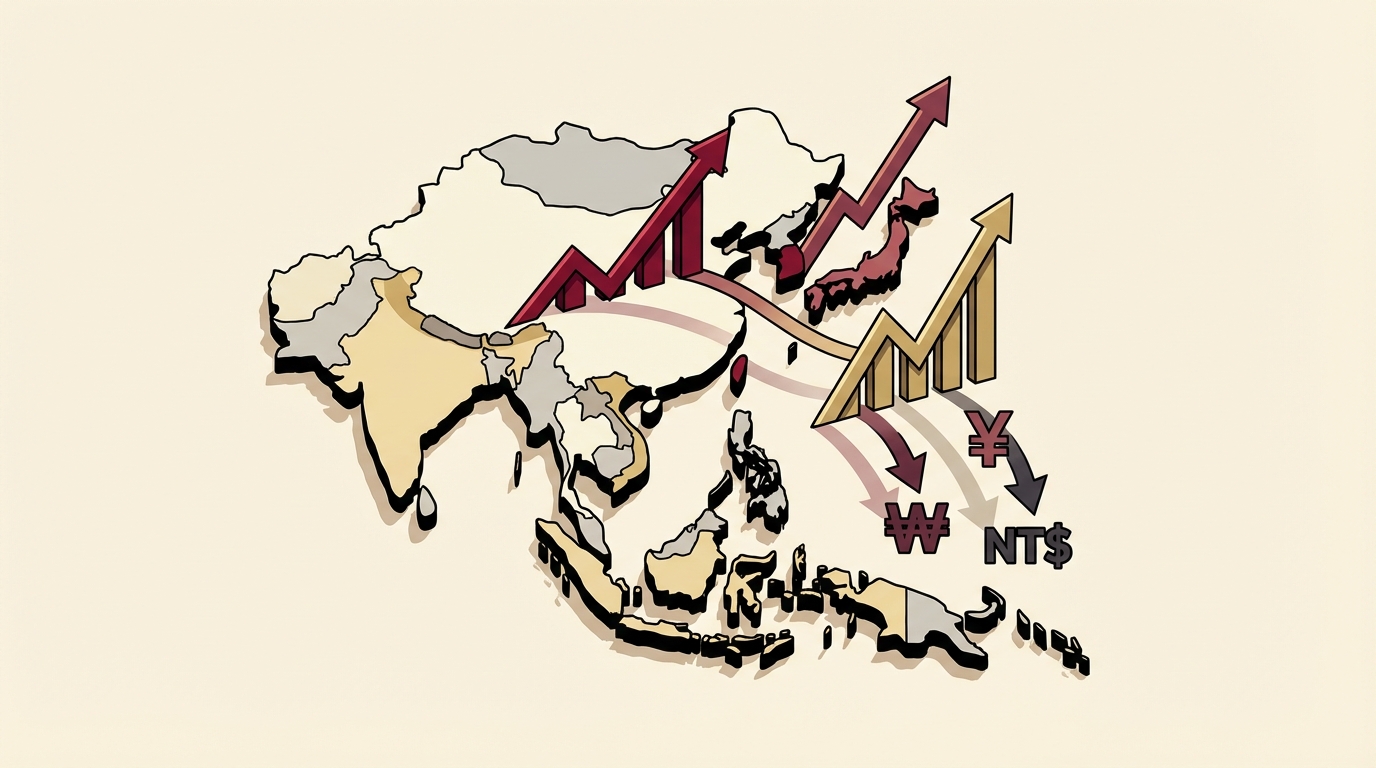
Asian equity markets are surging while their currencies weaken, breaking a long-standing correlation that has traditionally guided investment strategies across the region. The 30-day correlation between the MSCI Asia-Pacific Index and Bloomberg Asia Dollar Index fell below zero for the first time since September 2024, signaling an unusual disconnect between stock and currency performance.
South Korea exemplifies this split most dramatically. The Kospi rallied 76% throughout 2025 and continued climbing into 2026, even as the won dropped to a 17-year low. Similar patterns emerged in Japan, where equities gained despite the yen hitting 10-month lows, and Taiwan, where the Taiex rose 5.6% in early 2026 while its currency weakened.
AI Infrastructure Drives Stock Rally Amid Currency Pressure
The divergence stems from competing market forces pulling stocks and currencies in opposite directions. Enthusiasm for AI infrastructure investments is fueling equity gains across the region, with the MSCI Asia Pacific Index posting a 4% gain in early 2026, its strongest start since 1988. South Korea's stock market surged 7.4% in just the first four trading days of 2026.
 Mission Media
Meanwhile, currencies face downward pressure from fund outflows and rate cuts by Asian central banks attempting to buffer their economies against potential US tariffs. Regional growth forecasts have slowed to 3.9% for 2026, down from 4.6% in 2024, prompting central banks to prioritize economic support over currency stability.
"These markets are dancing to different tunes," said Homin Lee of Lombard Odier Singapore, explaining that stocks respond to sectoral themes while currencies move based on capital flows and broader economic factors.
Investors Reconsider Hedging Strategies
The unusual market dynamic has prompted global asset managers to reassess their regional exposure. Vantage Point Asset Management and Berenberg, which manages €39 billion (~US$41 billion) in assets, are both considering hedging their Asia positions to protect against currency volatility eroding equity gains.
Fortunately for investors, hedging costs have fallen to approximately 0.31% for major Asian currencies through three-month forwards, near yearly lows. This makes currency protection more affordable for those concerned about the disconnect.
Ian Samson, portfolio manager at Fidelity International, highlighted the unusual nature of the situation in South Korea specifically. "The fact that you have got these huge current account surpluses and you are not seeing the currencies participate at home, that's very strange," he noted, referring to the disconnect between Korea's strong trade position and its weak currency.
Temporary Disruption or Lasting Shift
Market strategists remain divided on the significance of the decoupling. Aninda Mitra of BNY Investments downplayed concerns about "modest currency pressure" for export-oriented economies, suggesting currency weakness could actually benefit companies that earn revenue abroad.
However, Ulrich Urbahn of Berenberg warned that persistent currency underperformance could "erode gains or heighten portfolio volatility" for investors without hedging protection. For unhedged global investors, strong local stock returns can be partially or fully offset by currency losses when converting back to their home currency.
Most analysts view the current split as temporary, with AI infrastructure investments remaining the dominant factor for Asian equity performance in the near term. The key question for investors and communications executives is whether this represents a brief market anomaly or signals a more fundamental shift in how Asian markets operate.
Want to reach thousands of marketing and comms professionals across Asia?
Get your brand in front of industry decision-makers.
Partner with Mission Media →