
Edelman Trust Barometer 2026: Asia's Diverging Confidence Gaps
Asia's trust landscape fractures sharply: Japan hits 90% insularity while China records 77% trust. Employers emerge as the most reliable trust anchor for communications leaders managing cross-marke...

Communications leaders from ANZ, SBS, and the Business Council of Australia will join Edelman Australia CEO Tom Robinson at CommsCon 2026 on March 25 in Sydney to unveil local findings from the 2026 Edelman Trust Barometer. The event takes place at Crown Sydney.
Australia's Trust Shift Sets the Scene
Robinson has indicated the 2026 report shows Australia moving from "a state of distrust" toward "neutral territory." That shift carries weight. Roy Morgan data places Australian government confidence at 72 out of 100, nearly 30 points below the neutral benchmark of 100. Meanwhile, 57.5% of Australian electors believe the country is heading in the wrong direction.
The CommsCon panel brings together Elizabeth Rudall, ANZ head of strategic communications, Ben Wicks, executive director of public affairs at the Business Council of Australia, and Mandi Wicks, SBS director of news and current affairs. The three panelists collectively bring over 80 years of communications and business experience.
Asia's Bifurcated Trust Landscape
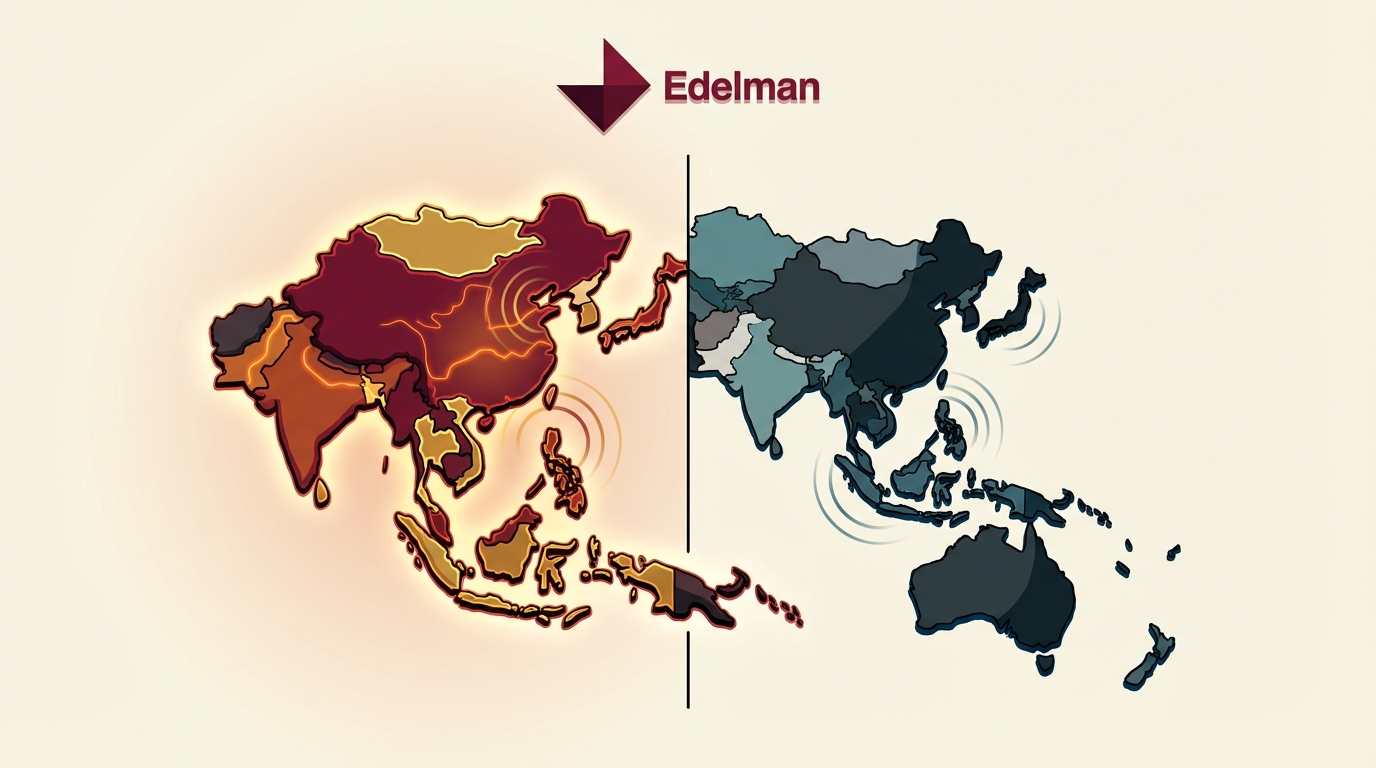
For Asian communications executives, the CommsCon data carries direct regional relevance. The 2026 Edelman Trust Barometer records a 90% insularity rate in Japan, the highest of any surveyed country. Insularity measures the share of people unwilling to trust those with different values or information sources. Globally, that figure sits at 70%.
Singapore records double-digit declines in company trust, placing it alongside Thailand, India, and China as markets experiencing significant institutional trust erosion. By contrast, China records 77% trust and Indonesia 76%, creating a sharply divided picture for executives managing cross-market mandates across both developed and developing Asian economies.
Employers as Trust Anchors
The 2026 Barometer identifies employers as the most reliable trust anchor in this fragmented environment. Edelman's research finds that 78% of employees trust their own employer, well above trust levels recorded for government (53%) and media (54%). Business overall scores 64% globally, up two points from 2025, and is the most trusted institution in 15 of 28 surveyed countries.
Separately, 73% of global respondents expect CEOs to actively lead trust building through diverse consultations and employee engagement. The business cost of failing to do so is measurable. According to the Barometer, 42% of employees would switch departments over belief differences with a manager, and 34% reduce effort on projects involving colleagues with differing political views.
What CommsCon Offers Asian Executives
The panel at CommsCon 2026 functions as a developed-market case study for the trust erosion trajectory now appearing across parts of Asia. Australia's low-income cohort records only 44% trust, well below the levels seen in China and Indonesia. The mass-class trust divide has also widened significantly since 2012, with high-income groups globally recording 62% trust versus 33% for low-income groups in top surveyed countries.
Edelman's Barometer finds that 75% of respondents endorse organizations consulting diverse views, and 74% support engaging critics as trust-building behaviors. These are practical actions communications teams can apply immediately.
CommsCon 2026 also features a keynote from crisis management expert Peter Wilkinson and a panel on how reputation affects share price, moderated by John McDuling. Tickets are available now.
Want to reach thousands of marketing and comms professionals across Asia?
Get your brand in front of industry decision-makers.
Partner with Mission Media →