
Pinkfong’s $406M Debut Shows CMOs that Global IP Is the New Growth Engine
Pinkfong's $406M IPO proves global IP franchises are the new growth engine for Asian entertainment companies. CMOs must rethink licensing and merchandising as core revenue drivers.

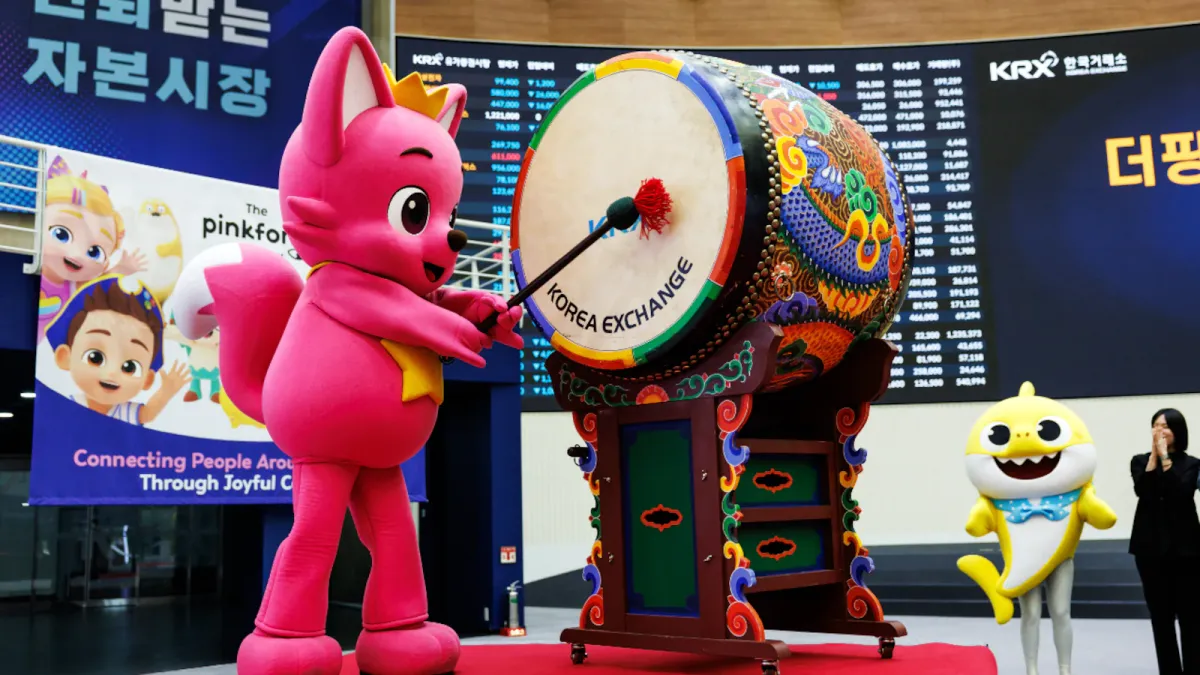
Pinkfong, the Seoul-based entertainment company behind viral hit "Baby Shark," raised 76 billion won (~US$53 million) in its KOSDAQ debut on November 18, 2025, pricing shares at 38,000 won amid record institutional demand.
Shares surged over 9% on opening day, valuing the company at 596.3 billion won (US$406 million). The offering attracted 2,300 institutional investors, with 99.9% of bids at or above the upper price band. Intraday trading saw shares spike as much as 62% before settling.
International sales drive growth momentum
The IPO validates Pinkfong's export-focused business model, with 76% of revenue generated from international markets, primarily North America and Europe. The company reported 45.2 billion won (~US$34 million) in revenue during the first half of 2025, maintaining a 20% operating margin.
Operating profit jumped 371% year-over-year in 2024 to 18.8 billion won (~US$14 million), driven by the Bebefinn franchise, which now accounts for approximately 40% of total earnings. "Bebefinn now generates more content revenue than Baby Shark," CEO Kim Min-seok stated in recent investor presentations.
The company's digital ecosystem spans 530 million app downloads and 280 million YouTube subscribers across content distributed in 25 languages. Pinkfong's AI dubbing tool OneVoice has reduced localization costs, enabling rapid deployment across global markets.
 Leighton Cosseboom
Media rights and licensing anchor monetization
Pinkfong's revenue model centers on merchandise licensing and media rights rather than advertising. The company's content ranked number one on Netflix Kids charts in 11 countries, demonstrating platform dominance that translates into licensing opportunities.
The Bebefinn franchise exemplifies this approach, overtaking Baby Shark within two years through coordinated releases across streaming platforms, retail partnerships, and location-based entertainment. NH Investment & Securities analysts noted Pinkfong's 25x earnings multiple suggests undervaluation versus the 40x industry average for comparable media companies.
Founded in 2010 by Kim Min-seok and Son Dongwoo, Pinkfong operates with 340 employees across offices in Seoul, Tokyo, Shanghai, and Los Angeles. To date, the company's 2016 "Baby Shark Dance" video has accumulated nearly 16.6 billion YouTube views, becoming the platform's most-watched content.
 Leighton Cosseboom
Expansion plans target new IP development
IPO proceeds will fund the development of three new intellectual properties by 2028, according to Kim Min-seok. The company plans expansion in Japan, Southeast Asia, North America, and Europe, with priority given to location-based entertainment ventures.
A 2025 South Korean Supreme Court ruling dismissed plagiarism claims against Pinkfong's "Baby Shark" arrangement, clearing legal uncertainties ahead of the public offering. The decision affirmed Pinkfong's version as an original arrangement of public domain material.
The listing positions Pinkfong alongside K-pop and K-drama as cultural exports from South Korea, testing KOSDAQ's capacity to support creative IP companies beyond traditional technology and biotech sectors. The Kim family's holdings are now valued at 246 billion won (~US$183 million) following the successful debut.
Want to stay up-to-date on the stories shaping Asia's media, marketing, and comms industry? Subscribe to Mission Media for exclusive insights, campaign deep-dives, and actionable intel.

Want to reach thousands of marketing and comms professionals across Asia?
Get your brand in front of industry decision-makers.
Partner with Mission Media →