
M+C Saatchi Posts Worst Results as Holding Company Model Falters
M+C Saatchi's 75% profit collapse and WPP's 87% market loss signal the end of holding company dominance. Brands now prefer independent agencies.


M+C Saatchi just reported the worst financial results in its history. The global advertising agency watched its profit before tax fall 75% in 2025, dropping to just £4.6 million from £18.1 million the year before.
The culprit, according to management? Australia. Things got so bad that when the company presented its full-year results to investors, it simply left Australia out. No slide, no explanation, no apology.
That tells you everything you need to know about where this industry is headed.
The Numbers Behind the Embarrassment
The scale of the Australian collapse is striking. Revenue in that market fell 31.9% over the full year. Across the broader Asia-Pacific region, net revenue dropped 22.3%. Globally, like-for-like net revenue fell 7.3% to £204.7 million, and statutory operating profit crashed 54.7% to £10.2 million.
Three client losses triggered the unraveling: Optus (which went to independent rival Droga5), Origin Energy, and Tourism Australia. The company also shut down Bohemia, its Australian media arm. Losing a handful of big clients should not be enough to threaten a global network. The fact that it nearly did is the real story.
To top it off, global CEO Zaid Al-Qassab exited on March 31, 2026. UK CEO Jo Bacon left at the same time. The company is now being run by interim executive chair Dame Heather Rabbatts, who told investors the business was "confident in targeting net revenue growth and operating profit growth in 2026." The gap between that statement and the financial reality is difficult to ignore.
A Sector-Wide Crisis, Not Just One Agency
M+C Saatchi's problems look less like a one-off disaster and more like an early warning signal when you look at the broader picture.
 Mission Media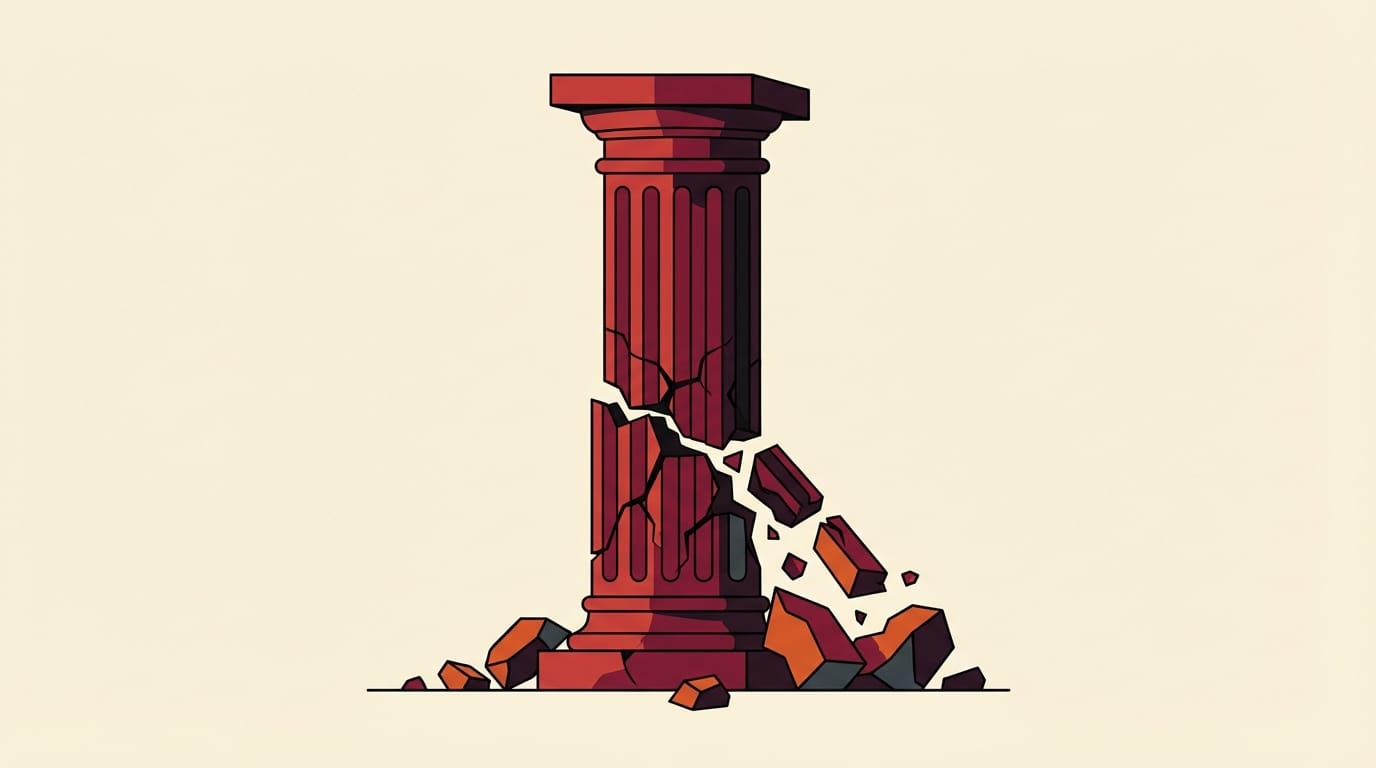
WPP, once the world's largest advertising group, has seen its market value fall from £24 billion in 2017 to roughly £3.1 billion today. That is an 87% destruction of shareholder value over eight years. The company fell out of the FTSE 100 (Britain's top 100 listed companies) in December 2025. Its own CEO now says: "We are no longer a holding company."
Meanwhile, Omnicom and IPG completed a merger in late 2025 that created the world's largest advertising group by eliminating roughly 10,000 jobs and retiring long-standing brands like DDB, FCB, and MullenLowe. The merger cost Omnicom US$2.14 billion in charges, wiping out its 2025 profitability entirely. This is not expansion. It is survival through consolidation.
The structural shift is also visible in market share data. The Big Six holding companies controlled 44.6% of US advertising spend in 2019. By early 2024, that figure had fallen to 29.6%. Brands are increasingly buying media and creative services directly, cutting out the agency middleman.
Looking for World-Class PR & Comms in APAC?
Tailored service packages for select brands and agencies.
What Is Actually Driving This
Cost-cutting alone is not a strategy. That is the lesson from M+C Saatchi, WPP, and the entire holding company playbook of the last decade. These groups were built on financial engineering, buying up independent agencies and promising clients they could access all their capabilities under one roof. When the model came under pressure, they cut headcount. When that did not work, they cut more. The underlying business did not transform.
Forrester predicts another 15% reduction in agency headcount in 2026, on top of the 8% already cut in 2025. The research firm also found that 85% of US senior marketing executives plan to review their agency relationships this year.
AI is accelerating the pressure. 60% of senior marketing leaders say they now spend less on agencies because of AI-driven capabilities they have brought in-house.
The one exception is Publicis. The French holding company posted 5.9% organic growth in 2025 and won 56% of all global new business billings across 1,485 pitches. The difference is not luck. Publicis built an AI-native data infrastructure and genuinely restructured its product offering rather than just restructuring its payroll.
The Independent Agency Opportunity
The clients walking away from holding companies are not disappearing. They are going somewhere else. Across Asia-Pacific, independent agencies are landing exactly the accounts that holding companies are losing. Optus chose Droga5, an independent. Other blue-chip brands in the region are following the same pattern.
Mission Media
The APAC advertising market grew just 4.6% in 2025, down from 7.9% the year before. That slower growth hits agencies with high fixed costs hardest. More agile independent shops can adapt faster.
As Michael Rebelo, CEO of Publicis ANZ, put it plainly: "The industry is getting smaller."
For marketers evaluating agency partners and for agency leaders deciding what to do next, M+C Saatchi's results are not just a cautionary tale. They are a live demonstration of what happens when a business mistakes cutting costs for having a strategy.
Want to reach thousands of marketing and comms professionals across Asia?
Get your brand in front of industry decision-makers.
Partner with Mission Media →


