
How OOH Advertising Is Sold Doesn't Match How Audiences Actually Move
Out-of-home advertising sales don't match how audiences actually move through cities. What this means for brands building connected campaigns across Asia.

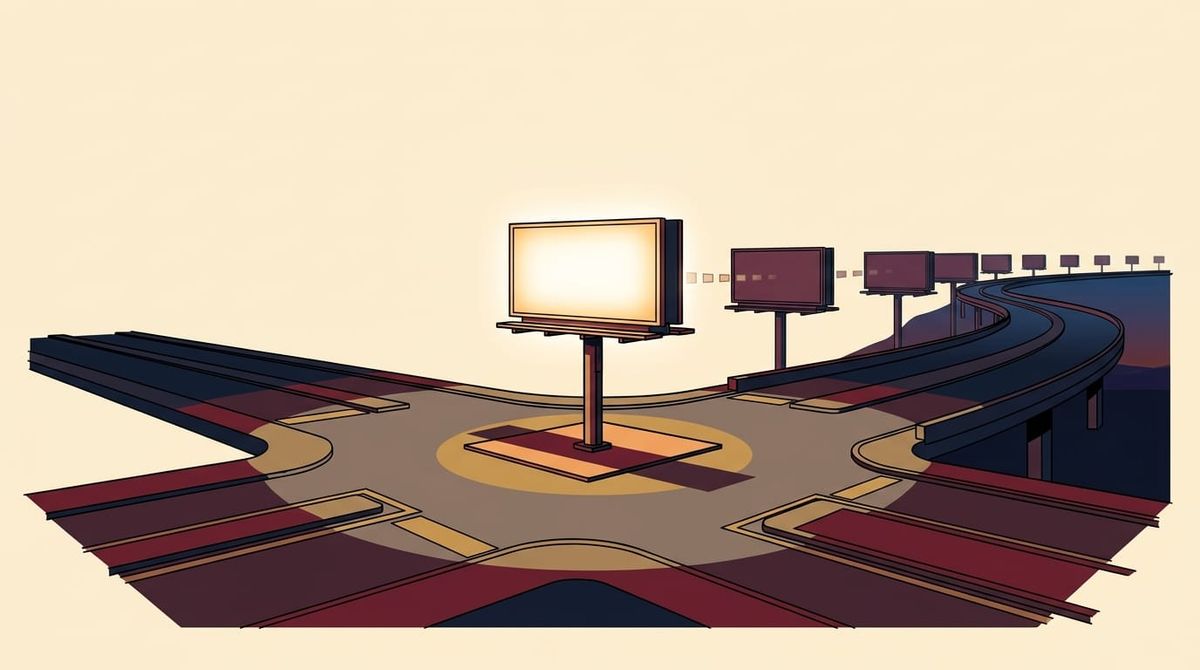
Walk through almost any major Asian city and you'll see a wall of digital screens. Subway corridors. Highway overpasses. Shopping mall atriums. The screens are new. The way they're being sold is not.
Out-of-home advertising (OOH, meaning any advertising you see outside your home, from billboards to transit ads) has spent decades building its commercial model around one idea: pick the best location, buy the space, deliver visibility. That model made sense when screens were static and audiences moved predictably. But the premise no longer holds.
A single industry observer is putting it plainly. As Rabih Bekai, Business Development Lead at Hills Advertising, writes in Campaign Middle East: "The future leaders in the sector may not simply be the operators with the largest number of assets. They may be the operators who best understand how audiences actually experience cities."
The Way People Move Is Not the Way OOH Gets Sold
People don't experience cities in isolated moments. They commute on the same routes. They pass the same corners. They build a mental picture of a brand across repeated, connected exposures over time. That's the audience reality.
The OOH sales reality is something different. Most buyers are still evaluating inventory the way a real estate agent values a corner plot: CPMs for isolated locations, landmark pricing for the highest-visibility point, placement strength without any account for how one screen connects to the next. The strongest single site wins the deal. What happens before and after that site is rarely part of the conversation.
This is the contradiction Bekai identifies. The market talks about performance and accountability and audience behavior. But it measures success through disconnected snapshots. A campaign built across scattered, uncoordinated assets doesn't behave the same as one built across a network that mirrors how audiences actually move.
When Networks Behave Like Networks, the Math Changes
The core insight in Bekai's argument is that OOH value is cumulative, not additive. A bridge placement on a major arterial road doesn't produce the same outcome as one placement in a network of coordinated touchpoints aligned with commuter movement. A connected corridor doesn't produce the same outcome as scattered availability across unrelated venues.
 Mission Media
The difference is structural. When exposure compounds across a journey, brands build recognition through repetition. That's how networks create value that individual sites simply cannot replicate. And once you accept that logic, the entire commercial model needs revisiting.
Digitization makes this shift possible in a way it wasn't before. The real impact of OOH's digital transformation, Bekai argues, isn't about putting a screen somewhere instead of a static poster. It's operational. Digital screens can adapt messaging in real time. They can structure delivery more intelligently. They can create continuity across environments rather than isolated static moments. That operational capability is the foundation for meaningful programmatic buying and more credible audience measurement.
But programmatic OOH won't scale effectively through fragmented infrastructure. When inventory is assembled through disconnected site selection rather than coherent network logic, measurement becomes inconsistent and dynamic delivery loses its value.
Looking for World-Class PR & Comms in APAC?
Tailored service packages for select brands and agencies.
The Commercial Logic Is Starting to Catch Up
The infrastructure is evolving faster than the commercial model around it. More operators are integrating with platforms that enable audience-based buying across networks rather than location-by-location deals. The shift is particularly relevant in APAC, where markets like India, Indonesia, and Thailand are home to hundreds of regional OOH operators with no single dominant player. Network-level scale in those markets requires aggregation that no single operator can provide alone.
What this means for brands is a gradually widening gap between what OOH can now technically deliver and what most deals actually buy. 59% of marketers still buy OOH only through direct deals in 2026, despite programmatic platforms offering unified buying across networks. Advertisers expect the same flexibility and measurability from OOH that they get from digital channels. Performance cannot continue to be understood purely through isolated locations.
The operators who adapt fastest aren't necessarily the ones with the largest footprints. They're the ones reorganizing their commercial logic around network behavior rather than individual asset ownership. As Bekai puts it: "OOH is no longer evolving only through scale. It is evolving through how scale itself is organised."
For brands planning outdoor campaigns, that shift has practical implications. Buying the strongest single site is no longer the proxy for a strong campaign. Understanding how your bought inventory behaves as a connected system, how exposure compounds across the routes your audience actually travels, is increasingly the question that determines whether a campaign actually works.
Want to reach thousands of marketing and comms professionals across Asia?
Get your brand in front of industry decision-makers.
Partner with Mission Media →


