
Inside Heineken's Push to Route 80% of Marketing Spend Through AI
Heineken's shift to AI-powered marketing through Freddyai signals a broader trend: consolidation is narrowing the creative ecosystem, with brands repeatedly choosing the same agencies.

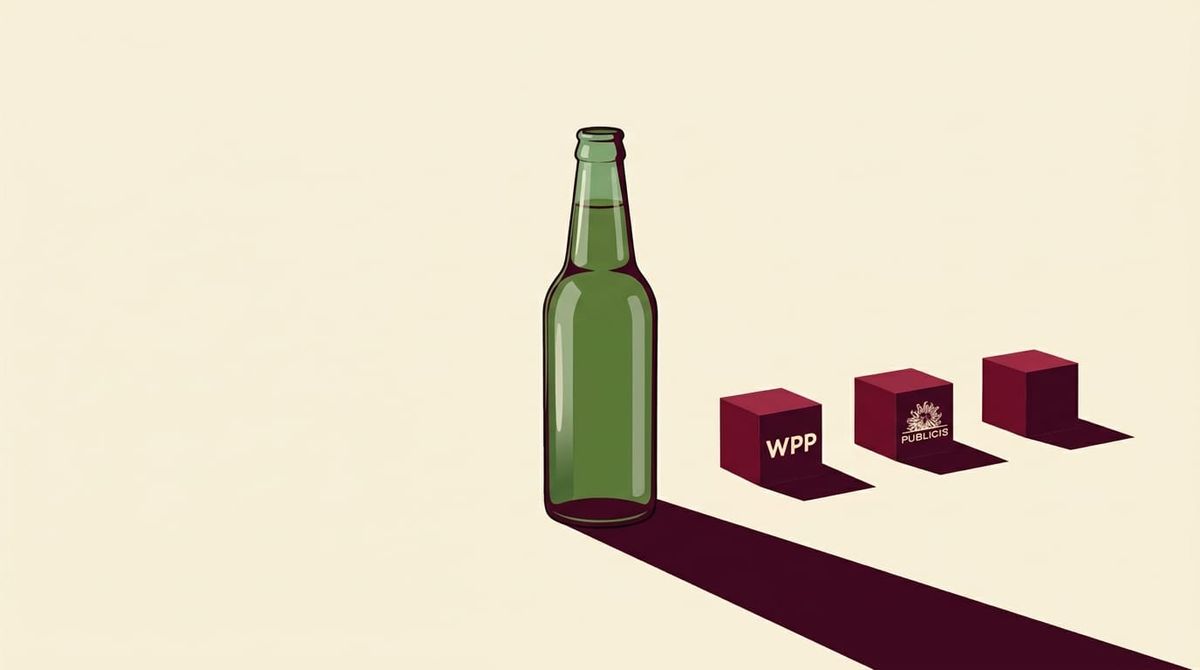
Heineken just made a big bet on simplicity. After completing a global review of its marketing agency partners, the brewer announced it is cutting its creative roster down to just three holding companies: Publicis Groupe, WPP, and Stagwell. Its media account stays with dentsu. The move affects major brands including Amstel, Birra Moretti, Desperados, and Tiger.
The company frames this as evolution, not retreat. "Moving to fewer, better and bigger agency partners is part of our broader Freddyai Commercial transformation," said Bram Westenbrink, Heineken's Chief Commercial Officer. The logic is clean: fewer partners means less friction, faster execution, greater consistency.
But the logic hides a growing risk that marketing leaders should examine closely.
The Cost-Cutting Engine Behind the Restructure
Heineken's consolidation is not purely a creative decision. It sits inside a much larger cost-reduction program called EverGreen 2030, which targets EUR 2 billion in total savings and may cut up to 6,000 jobs tied to its AI platform, Freddyai.
That platform is central to the story. By the end of 2026, Heineken expects roughly 80% of its marketing spend to flow through Freddyai, which acts as a virtual marketing agency powered by artificial intelligence. The three retained holding companies will not operate with full creative freedom. They will work inside an AI-governed system.
This means Heineken is not just consolidating agencies. It is fundamentally changing what agencies are asked to do.
When Everyone Picks the Same Three Partners
Heineken is not alone. Kenvue, the Johnson and Johnson consumer health spinoff, chose WPP and Publicis after its own global review. Estee Lauder handed its entire global media mandate to WPP. Mars went with Publicis and IPG. The pattern is consistent: when global brands run competitive pitches, they keep landing on the same two or three names.
 Mission Media
The result is a narrowing creative ecosystem. As one industry analysis noted, "when everyone has similar tools, capabilities and operating models, differentiation collapses." The competitive tension that drives agencies to do their best work disappears when they know the client has no real alternatives.
This risk is not hypothetical. Everest Group warns that specialized knowledge and creative excellence are routinely diluted when agencies merge or consolidate under a single client arrangement. The Omnicom-IPG merger, which closed in late 2025 and created the world's largest holding company with over US$25 billion in combined revenue, also retired creative networks FCB, MullenLowe, and DDB, further shrinking the pool of genuinely distinct creative options.
The APAC Question Consolidation Doesn't Answer
For Tiger Beer in Singapore, Desperados in Southeast Asia, and Amstel across North Asia, the cultural stakes are high. APAC markets are not interchangeable. What resonates in Seoul does not automatically translate to Jakarta or Shanghai.
Campaign Asia has flagged that the biggest client fear in consolidation is waking up and not knowing who your agency team is. That risk is amplified across markets where local knowledge is the difference between a campaign that connects and one that offends.
Bain and Company analysis underscores this: brands that become too focused on optimizing their agency structure risk losing sight of the actual business results they are trying to drive. Clients want outcomes, not organizational elegance.
Looking for World-Class PR & Comms in APAC?
Tailored service packages for select brands and agencies.
The Creative Trade-Off Heineken Isn't Advertising
Heineken's announcement is full of efficiency language. "Deeper collaboration." "Sharper strategic focus." "Greater speed." These are the standard claims of every consolidation.
What is not said: that VCCP, an independent agency outside any holding company, topped the 2025 global creative rankings. The world's most awarded creative work was produced by a firm systematically excluded from the consolidated rosters that Heineken and its peers are building.
That is not an argument against consolidation. It is an argument for knowing exactly what you are trading away.
Want to reach thousands of marketing and comms professionals across Asia?
Get your brand in front of industry decision-makers.
Partner with Mission Media →


