
BBC, Disney, Snap Cut 3,000 Jobs Amid Media Industry Shake-up
BBC, Disney, and Snap announce 3,000 job cuts globally in April 2026, with AI and cost pressures driving redundancies. APAC operations face significant exposure.

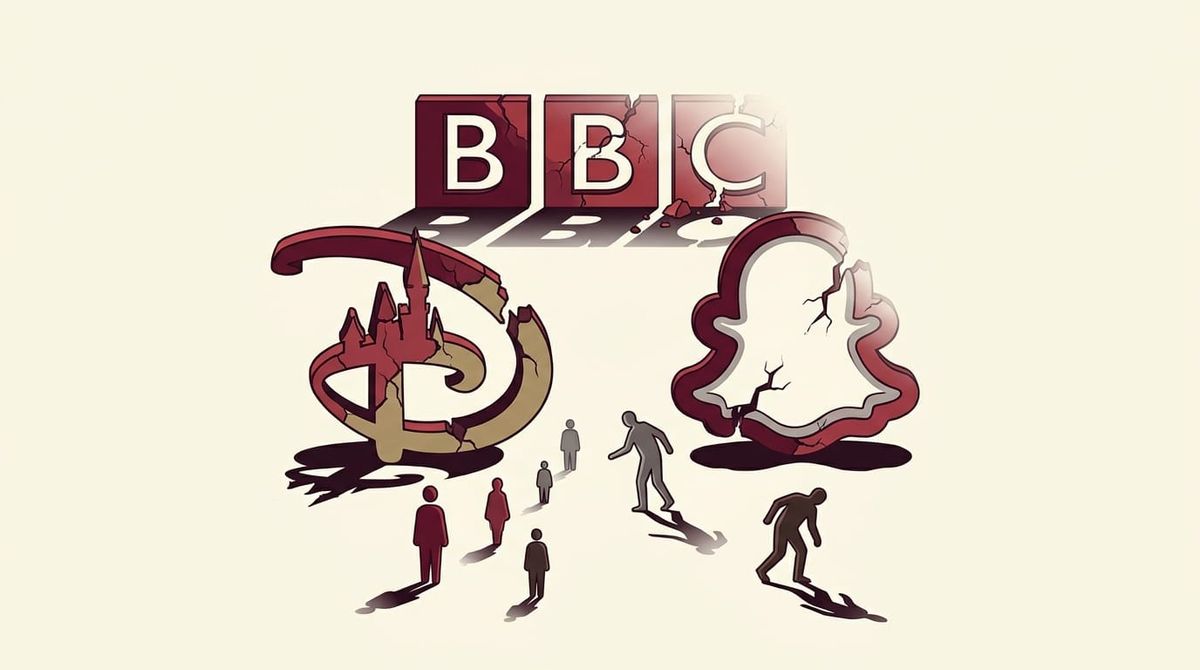
Three of the world's largest media companies announced major job cuts within days of each other in April 2026, marking one of the biggest waves of media industry redundancies in recent memory.
The BBC, Disney, and Snap together plan to eliminate roughly 3,000 positions globally. All three companies operate in Australia, with potential exposure across the Asia-Pacific region.
BBC Targets A$946 Million in Savings Over Two Years
The BBC will cut between 1,800 and 2,000 jobs, representing approximately 10% of its total workforce. It is the broadcaster's largest redundancy round since its 2011 "Delivering Quality First" program, which also eliminated around 2,000 roles over five years.
Interim Director-General Rhodri Talfan Davies announced the cuts at an all-staff meeting on April 15, 2026. "The gap between our costs and our income is growing," he said. "This is being driven by a number of factors: production inflation remains very high; our license fee and commercial income is under pressure; and the global economy remains turbulent."
The BBC aims to save £500 million (A$946 million) from its £5 billion annual operating cost base over two years, with the bulk of savings targeted in 2027 and 2028.
BBC Studios Australia employed 250 staff in 2025 and generated A$190.6 million in revenue with A$6 million in taxable profit, a thin 3.1% profit margin that leaves the local operation exposed to cost-allocation pressure from London.
Snap Cites AI as a Direct Driver of Headcount Reduction
Snap Inc. will lay off approximately 1,000 employees, equal to 16% of its global workforce, and cancel 300 additional open roles. The company projects savings of more than A$700 million in 2026, net of A$130 million to A$180 million in restructuring costs.
 Mission Media
CEO Evan Spiegel explicitly named artificial intelligence as a reason for the cuts, stating that AI enables teams to "reduce repetitive work, increase velocity, and better support our community, partners, and advertisers."
Snap's Australian operation employed just 64 people as of 2023 filings. A proportional application of the 16% global cut ratio would eliminate approximately 10 local roles, though small offices often face disproportionately larger cuts during global restructuring.
Disney Continues Multi-Year Workforce Reduction
Disney will eliminate around 1,000 roles across marketing, studios, television, ESPN, product and technology, and corporate functions. New CEO Josh D'Amaro said the company needs "a more agile and technologically-enabled workforce to meet tomorrow's needs," also citing AI as a factor.
The April 2026 cuts are part of a larger pattern. Disney has reduced its global workforce by more than 8,000 roles since 2022, from a pre-cut base of approximately 231,000 employees.
Walt Disney Australia and New Zealand employed 350 staff and generated A$765.2 million in revenue with A$71.8 million in profit in 2024, a 9.4% profit margin. The stronger financial position may offer some protection, though marketing and corporate roles remain at risk.
Looking for World-Class PR & Comms in APAC?
Tailored service packages for select brands and agencies.
A Broader Wave of Media Industry Restructuring
The three announcements did not occur in isolation. Warner Bros. Discovery reduced its workforce by 10% in July 2025. Paramount Global cut thousands of roles in October 2025. The BBC itself eliminated 130 World Service jobs in January 2025 before the broader April announcement.
The National Union of Journalists described the BBC cuts as "brutal," warning of morale damage and reduced programming output, according to reporting by The Independent.
For Asia-Pacific markets, the cumulative effect of these reductions points to tighter content production budgets, reduced co-branded partnership opportunities, and accelerated AI adoption across media operations. A surge in senior freelance talent entering the market is also a likely near-term consequence as experienced professionals exit these organizations.
The full scope of cuts to Australian and Asian operations has not yet been confirmed by any of the three companies.
Want to reach thousands of marketing and comms professionals across Asia?
Get your brand in front of industry decision-makers.
Partner with Mission Media →


