
How Competitors' Downfall Built Bunnings' Trust Brand
Bunnings topped Australia's trust rankings for nine quarters. But the story isn't about what Bunnings did right—it's about what competitors did catastrophically wrong.

For nine quarters straight, a hardware chain has held Australia's most trusted brand title. Not a bank. Not a tech giant. Bunnings.
Roy Morgan Research, which tracks sentiment across 1,000 brands monthly, handed Bunnings its "Best of Best" award for 2025 for the second year running. The streak runs from Q4 2023 through Q4 2025 without interruption. On paper, it is a remarkable brand story.
But the real story is messier and more interesting than the headline.
What the Trophy Doesn't Measure
Roy Morgan's Risk Monitor surveys roughly 2,000 Australians per month. It captures broad brand sentiment, not granular customer experience. That distinction matters enormously.
At the macro level, Bunnings looks outstanding. But scroll through Trustpilot or ProductReview.com.au and a different picture emerges: staff reported as hard to find on the floor, phone wait times of up to 30 minutes, online orders cancelled without notification, delivery timelines blowing out from an advertised two to three weeks to seven weeks. Drill bits that fail after first use.
These are not the experiences of a brand that has earned its trust crown through operational excellence. They are the experiences of a brand benefiting from a measurement method that cannot see them.
The Conversation noted the same paradox after Bunnings toppled Woolworths: what we call "trust" in these surveys is often better described as familiarity filtered through goodwill. Bunnings creates enormous amounts of goodwill at the community level. That goodwill shows up in surveys. Individual bad experiences, spread across a large customer base, do not.
The Beneficiary Effect
Here is what the narrative rarely acknowledges. Bunnings did not necessarily get better. Its competitors got dramatically worse.
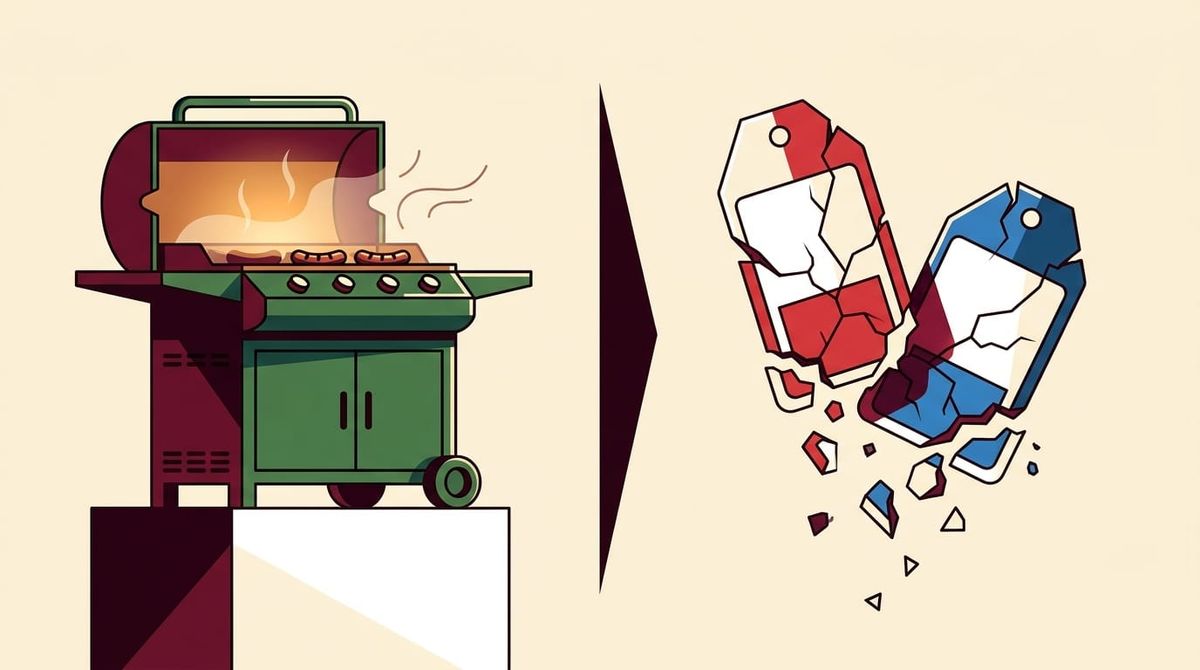
Woolworths fell 239 ranking places from most trusted to most distrusted in Australia between 2022 and October 2024. Coles fell 237 places over the same period. The trigger: ACCC allegations of misleading discount pricing and a public perception that post-COVID grocery price hikes were permanent and deliberate. The financial toll was real. Woolworths and Coles lost a combined A$4.1 billion in brand value, a 31% wipeout in a single year.
Roy Morgan CEO Michele Levine's framing captures the dynamic precisely: "Bunnings, Aldi and Kmart are once again Australia's most trusted brands, all operating on an everyday low prices model that helps them avoid accusations of fake discounts." In other words, the top three trusted brands are unified not by what they did but by what they avoided.
When the most visible players in Australian retail are embroiled in pricing scandals, being reliably non-controversial becomes a competitive advantage. QUT's Centre for Future Enterprise trust research found that trust increasingly functions as a relative measure, not an absolute one. Australians trust the least-bad option as much as they trust the genuinely good.
Where Bunnings Is Genuinely Strong
The cynical read should not obscure what Bunnings has actually built. Some of the trust foundation is real.
The sausage sizzle program is frequently dismissed as a charming quirk. It is actually one of Australia's most effective community investment tools at scale. From 2014 to 2018, more than 160,000 sausage sizzle events across 237 stores raised A$144 million for local community groups. In a single recent year, 34,000 barbecues raised A$40 million. The mechanics are smart: the events convert commercial real estate into community infrastructure, build genuine local goodwill, and increase dwell time and impulse purchases simultaneously. It is not pure altruism, but it is not purely performance either.
Digitally, Bunnings is more sophisticated than its warehouse aesthetic suggests. By December 2024, bunnings.com.au was the most-visited brick-and-mortar retail website in Australia, ahead of every competitor by six million monthly visits. The Hammer Media retail network, launched in 2025, reaches 14 million website visitors monthly, with 300 in-store screens across 150 stores. Click and Collect accounts for 40% of online orders. These are real infrastructure investments, not narrative.
PwC's customer loyalty research finds that two-thirds of consumers are more likely to stay loyal when they genuinely feel a brand cares about them. Bunnings' community programs satisfy this condition at a mass level. The question is whether that caring extends inside the stores, where Glassdoor reviews suggest staff frequently feel undertrained and stretched.
Looking for World-Class PR & Comms in APAC?
Tailored service packages for select brands and agencies.
The Edges Are Starting to Show
The harder question is whether Bunnings is managing its trust equity carefully or spending it.
Its 2025 "Better Together" strategy included a candid acknowledgement of the "perception of alleged mistreatment of some suppliers." That supplier trust gap never shows up in Roy Morgan's consumer-facing rankings. But it represents a genuine crack in the brand's reputation that brand strategists should not ignore.
The category expansion into pets and expanded home cleaning also introduces risk. Bunnings' trust is built on a specific positioning: the expert partner for home improvement. Halo effect research, drawing on Journal of Consumer Research data, shows strong brand associations can lift perceived value by up to 22%. But that halo is attached to the existing positioning. Expand too far, and the positioning loses its sharpness.
Marcel Wijnen of brand agency Hulsbosch put it well in Mumbrella: "Brand trust is not a static asset, but a living ecosystem that must be nurtured at every turn." The warning applies to Bunnings as much as anyone.
Nine quarters at the top is a real achievement. But 68% of Australians say they will not buy from a brand they do not trust, according to Twilio's 2024 Consumer Preferences Report. Bunnings has the crown. Keeping it requires more than a sausage sizzle and a trust vacuum left by others.
Want to reach thousands of marketing and comms professionals across Asia?
Get your brand in front of industry decision-makers.
Partner with Mission Media →


