
Why Ma Yansong's Museum Design Attracts Record Audiences
A newly designed science museum in Hainan attracted 350,000 visitors during its trial opening. Learn how architect Ma Yansong's innovative spiral design became a model for community-centered museum spaces.

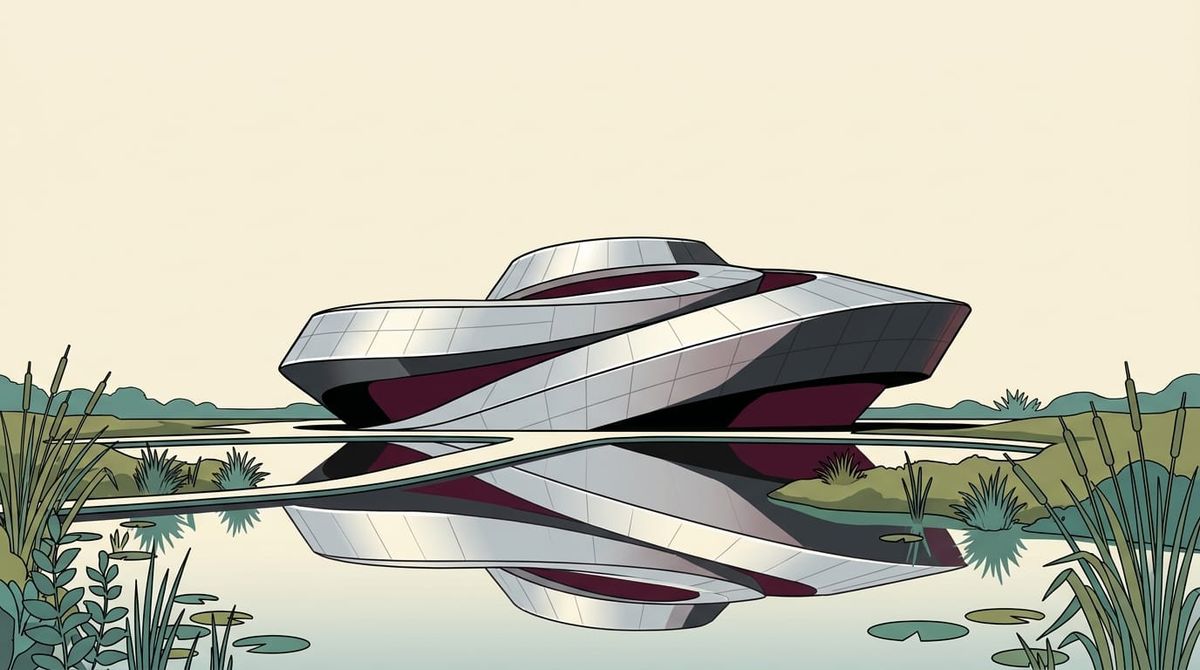
A new science museum in Hainan has done something unusual. It drew more than 350,000 visitors during its trial opening period. On its busiest days, 5,800 people walked through the doors.
The museum was designed by Ma Yansong, founder and principal partner of architecture firm MAD. It sits on the edge of Wuyuan River National Wetland Park in Haikou, Hainan. And it looks nothing like a typical museum.
What makes the Hainan Science Museum worth paying attention to is not just the visitor numbers. It is the thinking behind the design.
The Building Is the Content, Not the Container
Most museums work the same way. You walk in, find a gallery, look at exhibits, and leave. Each subject sits in its own room.
Ma designed the Hainan Science Museum differently. A single spiral route connects every gallery in the 46,528-square-meter complex, walkable in either direction. Start at the top, and you descend through space and ocean, then rainforests and tropical agriculture, then arrive at a hands-on children's level. Subjects flow into one another rather than sit behind separate doors.
"I wanted the project to be built on the idea of flow and chaos," Ma said. "Space, function, and knowledge to flow into one another, freely. Different subjects should connect, overlap, and stay open."
He made a pointed observation about science education today: "If artificial intelligence can already answer almost any question, a science museum's job is no longer to deliver facts. It is to teach children how to ask them."
Three concrete core tubes carry the entire spiral, eliminating columns from the exhibition floors. The building floats above its reflecting pools. Outside, 843 fiber-reinforced polymer panels form a silver shell that shifts with daylight and weather.
Built for Daily Community Use, Not Occasional Visits
More than 30 schools and kindergartens sit within a three-kilometer radius of the museum. Ma conceived the building from the first sketch as civic infrastructure for those families, "closer to a public library than a destination landmark."
 Mission Media
A wide canopy lifts off the ground floor, shading an open public plaza beneath the building and pulling public space under the museum itself. The 46,528-square-meter complex also includes a planetarium, a giant-screen cinema, a sunken plaza, and outdoor areas for plant and agriculture education, all linked by a covered walkway.
The visitor numbers are a downstream result of that upstream intent. The surrounding community was designed into the building before it opened.
Looking for World-Class PR & Comms in APAC?
Tailored service packages for select brands and agencies.
A Moment of Recognition for the Architect
The museum opens at a high point in Ma Yansong's career. In 2025, he was named one of TIME magazine's 100 Most Influential People, one of only two architects on the list. That same year, he curated the China Pavilion at the 19th Venice International Architecture Biennale. In 2026, he was elected an Honorary Fellow of the American Institute of Architects.
These recognitions did not create the visitor numbers. But they are part of the same story: a designer with a clear philosophy, applied consistently, produces results that match the intent.
For anyone thinking about how institutions build audiences, the Hainan Science Museum is a clean example. The building communicates its purpose without a press release. The 350,000 visitors in four months are the proof.
Want to reach thousands of marketing and comms professionals across Asia?
Get your brand in front of industry decision-makers.
Partner with Mission Media →


