
Nine Consolidates 120 Newsroom Systems Into Cloud-First Operation
Nine consolidates 120 systems into cloud and compresses 100 job titles into nine. Real-time, multi-platform workflows are reshaping how CMOs pitch broadcast media.

Nine's TV news boss just told 800 staff their jobs are changing. Not tweaking. Changing fundamentally.
On Thursday, Fiona Dear, Nine's Executive Director of News and Current Affairs, briefed her national newsroom on the most significant technology overhaul the division has seen in decades. Approximately 20 roles will be made redundant across Sydney, Canberra, the Today Show, and foreign bureaus. The people losing their jobs are part of a broader shift that will eventually touch every single role in the building.
This isn't a budget cut dressed up as innovation. Dear was blunt: "Cost is not driving our decision-making."
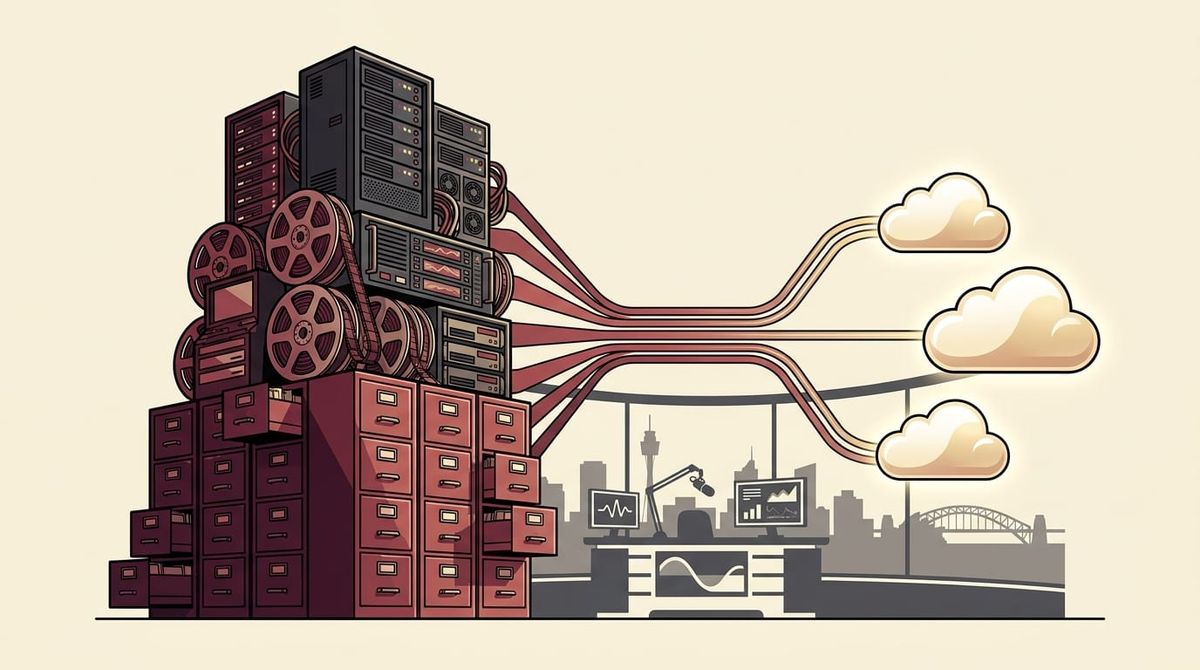
From 120 systems down to three
Last June, Nine's newsroom ran on 120 different systems. Different states. Different shows. Each with their own technology, assembled over decades of acquisitions and legacy deals.
 Mission Media
When the transformation is complete, that entire infrastructure will have collapsed into just three cloud-based platforms, all bespoke-configured for Nine's specific needs. The goal is a "story-centric" newsroom, where each piece of content is treated as its own asset, not just a segment in a bulletin.
What does that mean in practice? A story produced by a journalist in Canberra can be simultaneously distributed across broadcast, digital, and social platforms, all from the same workflow. Multiple staff in different cities can edit the same story at once.
RTL in the Netherlands and NBC in the US already run this model. Nine is following an established international playbook, not inventing one.
Looking for World-Class PR & Comms in APAC?
Tailored service packages for select brands and agencies.
100 job titles becoming nine
The harder number sits inside the restructure itself.
Nine's 800-person newsroom currently has 100 distinct role types. Camera operators do camera. Editors edit. Producers produce. Each specialty operates inside its own silo.
Under the new model, those 100 titles compress into just nine. Camera operators will be required to edit. Video editors will be required to shoot. The specialist silos collapse into multi-skilled generalists.
The first 315 affected staff in Sydney, Canberra, Today, and foreign bureaus begin transitioning in August. The Today Show follows in October.
Nine framed this as reskilling, not downsizing: "It isn't about doing the same work with fewer people to save money," Dear wrote to staff. "It's about acknowledging that the work itself is changing across our industry and we must adapt to survive and thrive."
What this signals for anyone pitching broadcast media
The velocity of broadcast news is accelerating. That's the buried lede in Nine's announcement.
Mission Media
A story-centric newsroom doesn't wait for the 6pm bulletin slot. It pushes content the moment it's ready, across whatever platform will carry it. That changes the calculus for anyone trying to place a story with a broadcaster.
Pitching a single asset designed for linear TV is increasingly misaligned with how cloud-first newsrooms process content. Broadcasters optimizing for multi-platform, real-time distribution need stories that travel. Video clips, formatted images, quotable soundbites, materials that can be cut and distributed across formats without extra production steps.
Nine is investing in the infrastructure to move faster. The marcomms teams that adapt their pitching approach to match that speed will have an advantage. Those still pitching for the 6pm slot are playing by rules the newsroom is actively dismantling.
"Once finished," Dear told staff, "we'll all be using our new skills and knowledge in a modern, cloud-based newsroom that sits amongst the world's best."
Whether that turns out to be true depends entirely on whether Nine can execute a transformation of this scale without losing the institutional knowledge it's simultaneously restructuring out of existence.
Want to reach thousands of marketing and comms professionals across Asia?
Get your brand in front of industry decision-makers.
Partner with Mission Media →


